I spent years trying every strategy imaginable to land international remote jobs and freelance clients. I left a 9 to 5, got fired, and then dove headfirst into remote work. I applied to hundreds of opportunities and kept learning what works and what does not.
After testing dozens of tactics, I landed on a simple, repeatable five-step process that will help beginners move from confused applicant to hired freelancer or remote employee. Here are the exact steps I recommend, and how to use them right away.
The five-step roadmap
- Find clarity
- Get knowledge
- Get proof of work
- Build a portfolio that tells a story
- Validate, refine, then acquire clients strategically
Step 1 — Find clarity: start at the beginning, not the end
Most people start with “Where can I find remote jobs?” and then apply everywhere. That is backwards. The first question is not which website to use. The first question is what you want to offer and who needs it.
Ask yourself:
- What skill do I already have that can be sold remotely?
- What can I learn quickly that is in demand right now?
- Which niche fits my strengths and interests?
Without clarity, you will apply to hundreds of jobs and get nowhere. Niches become crowded quickly. For example, “general virtual assistant” has been oversaturated in recent years. Get specific about the services you offer and the clients you want to serve.
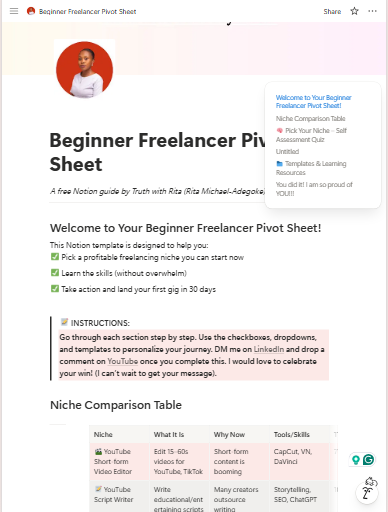
If you are not sure where to start, I created a free Notion sheet that will help you find out where to start now.
Step 2 — Get knowledge: learn with purpose
Being good at your craft matters more than applying everywhere. Focus on genuine learning, not just a single course or a few YouTube videos.
How to learn efficiently:
- Search job descriptions for the role you want. The goal is not to apply but to spot recurring responsibilities and required tools.
- Read 15 to 20 job listings and note patterns. What do employers repeatedly ask for?
- Ask a mentor or use a tool like ChatGPT to convert those job descriptions into a 60 to 90-day learning plan that makes you competent at the task.
- Start with free videos and tutorials to grasp basics, then use targeted paid courses for gaps you still need to fill.
When you become genuinely good at a skill, client acquisition becomes much easier. If possible, find a mentor who will provide feedback and accelerate your progress.
Step 3 — Get proof of work: show, do not just claim
Employers and clients want proof you can deliver. Saying “I am a content writer” is meaningless without examples that show results.
Ways to build proof of work:
- Volunteer for a nonprofit or help a small business for free to get real projects.
- Take small paid gigs on marketplaces to get client feedback and metrics.
- Collect testimonials and concrete outcomes like engagement numbers, conversion improvements, or process optimizations you implemented.
Proof of work gives clients confidence and reduces the risk they see in hiring someone new.
Step 4 — Build a portfolio that tells a story
A portfolio is more than a list of links. Tell a story with each project:
- What was the problem?
- What did you do?
- What was the outcome? Use numbers when possible.
- What skills and tools did you use?
I use a Notion-based portfolio template because it lets you present case studies clearly and professionally. Whether you use Notion or a website, your portfolio should make it obvious what you can deliver and for whom.
Not sure how to create a portfolio? Click here to get my portfolio template.
Step 5 — Validate, refine, then find clients
Validation comes from feedback and real work. Once you have proof, refine your offer based on what clients actually request. For example, you may start as a content writer and discover that most clients hire you for LinkedIn ghostwriting. Pivot and package that as a core service.
After refining your offer, move into client acquisition. There are several channels to try, each with pros and cons:
- Job boards — decent for finding verified remote roles, but they often produce the fewest wins for beginners.
- Freelance marketplaces — Upwork, Fiverr, and others are great for getting initial paid work and client feedback.
- Social media — LinkedIn, X, and Instagram are powerful for pitching and building a visible presence.
- Agencies and outsourcing companies — apply to smaller agencies; they often hire talent and expose you to fast-paced, varied work.
Apply strategically — quality over quantity
Applying and praying do not work. The way you reach out is the difference between getting an interview and getting ignored. Tailor applications, write concise value-focused messages, and make it easy for the employer to see the fit.
What strategic applications look like:
- Match specific requirements from the job description in your message and portfolio case studies.
- Send short, client-focused emails or DMs that explain what problem you will solve immediately.
- Highlight a relevant case study or quick example of your work in the first lines.
- Follow up politely if you do not hear back within a week.
Being intentional about how you apply will put you ahead of most candidates.
Action plan for day one
If you are starting today, follow this mini plan:
- Pick one skill or niche to test for 30 days.
- Read 15 job descriptions and write down the recurring requirements.
- Create a 30 to 60-day learning checklist and complete at least 5 real tasks or projects.
- Do one free or low-cost project to get a testimonial.
- Build one case study in a simple portfolio and send five tailored applications or pitches.
Closing advice
Obsessing over destination sites or tools is common, but the real progress happens when you go back to basics: choose a niche, learn intentionally, build real proof, present it well, and apply with strategy. Do those five things, and you will see momentum.
“When you are exceptionally good at what you do, client acquisition becomes easier.”
If you want the tools I use, I built a beginner freelancer pivot sheet and a Notion portfolio template to help you map skills and showcase work. I am also building a course that breaks down the beyond-and-above remote job application strategy, and I will open a waitlist for early access and bonuses.
Start small, be consistent, and focus on becoming genuinely useful. That is what gets remote jobs and freelance clients.