
Making your first $1000 as a content writer involves taking a few intentional long-term steps that look like this:
- Learning how to write good content that bots (search engine & AI) and humans love to read
- Understanding how to serve both the business (promote products and services) and readers
- Building work experience
- Creating a portfolio of your best works
- Positioning yourself for opportunities
- Applying to jobs/reach out to clients
- Building momentum and scaling (create a client pipeline + build a personal brand).
It took me 6+ years to truly understand these steps after working full-time as a content writer across 7 continents for different businesses.
I will help you quickly understand these steps in less than 30 minutes.
If you understand how to win every step of this process, you are on your way to becoming a profitable content writer, even if you have zero experience now!
You might be wondering:
If this is all it takes, then it looks pretty straightforward. I can check each box as I proceed.
That is partially true, but every step is nuanced. I mean, it is not a “done and dusted” situation for all of the steps.
That means it is a long-term, continuous process; something you will have to do throughout your career. However, you can shorten your learning curve across each step and learn simple hacks to reach your goals quicker.
How do you do that?
That is exactly what I will share with you in this article, following the few simple steps listed above:
Step 1: Learn how to Write Good Content for Humans and Bots (search engines and AI bots)

This is the most important step, because it makes all the difference.
What does it mean to write good content?
It means to write clear content. Content that clearly satisfies search intent and clearly delivers on the promise without confusion.
Once anyone gets more confused about a topic after reading your article, then you haven’t written good content.
How do you write clear content?
You write clear content by intentionally crafting every aspect of your article (from deciding on the title/topic to the CTA and conclusion). Understanding the purpose of every segment and how they tie to the general idea of the article.
Here’s a quick step-by-step guide to achieving good content:
a. Pick a great topic
Picking your topic is one of the most important aspects of writing a good article. This is the first thing people will see, and decide whether or not to continue with the article.
You have to be intentional about picking your topic. Here is a quick way to do it right:
- Write down the idea you are considering
- Research what people are already searching for around that idea ( idea validation).
You want to answer questions people are already asking.
I use keyword research tools like Ahrefs, Google keyword planner, etc., to find low competition keywords related to the idea I already wrote down.
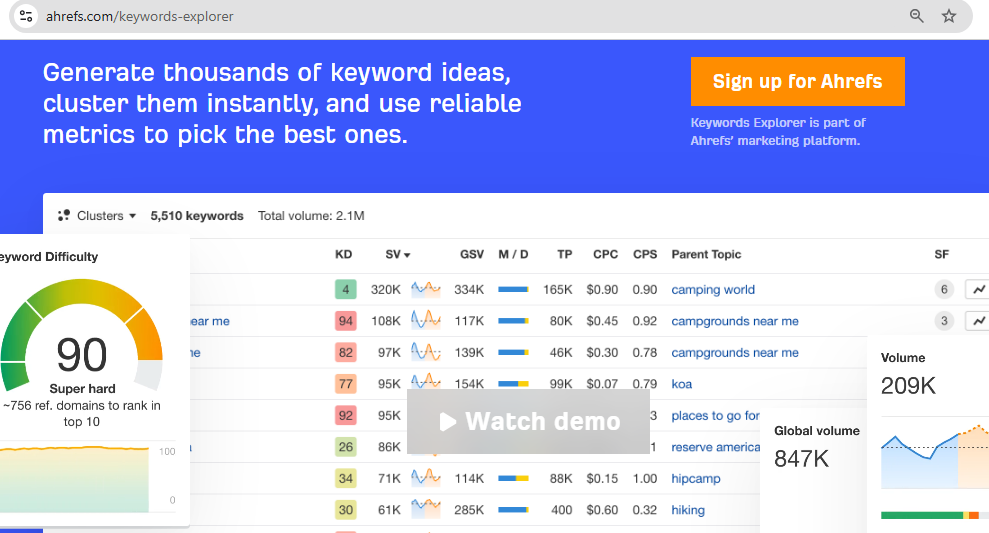
Image source: Ahrefs keyword explorer homepage
Do a simple Google search to see available information on that topic.
The essence of doing this is to find out the knowledge gap.
- What aspect of the information is everyone leaving out?
- What is unnecessary?
- What are people mostly interested in around this topic?
I like to look for an uncommon gap (more like coming from a contrarian approach). If it is a popular topic, I will look for an uncommon angle to make my topic stand out while leveraging existing demand.
For example, if I want to write an article about “how to grow on social media.”
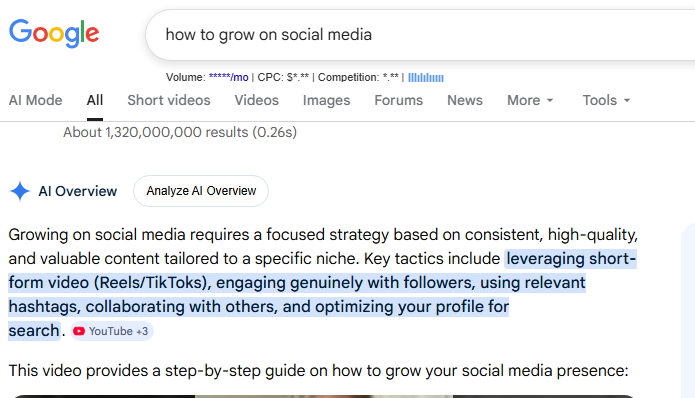
Image source: Google SERPs
Most articles here talk about the importance of consistency. To give my article a unique approach, I will come from a different angle that says something like:
“7 simple things I did to grow 20k followers on social media in 3 months without posting every day”
I am still talking about how to grow on social media, but coming from a different angle (without posting online every day). I am saying something different from what everyone has heard.
This topic will attract people who want to grow on social media but can’t afford to post every day. It can also attract people who post every day, but do not see growth.
3. Pique curioisity
Another thing I do while crafting my topic is to pique curiosity. There are many ways to do so.
- You can ask a question:
Do you know you can make thousands of dollars as a content writer without freelancing?
- Take a contrarian approach (just like what I did with the title)
- Make your idea very specific (add elements like time frame, color, etc.)
The more specific you are, the clearer your title.
4. Knead your title
Think of it as kneading dough. I like to bring in all the elements, merge them into one scroll-stopping title.
- I modified the title based on the search
- Merge it with my original idea
- Add an information gap
- Get specific about important details
This is how most of my attention-grabbing titles were birthed.
We’ve learned how to craft an attention-grabbing article. Let’s get into the introduction of your article.
B. Write a good article introduction
Once you have a scroll-stopping title, follow up with a complimentary introduction. You don’t want your readers to bounce after clicking on your title.
Imagine being served a well-plated pasta, just to have a taste, and you can’t even swallow. How would you feel?
Disappointed right?
That is exactly how readers feel when the introduction doesn’t justify the reason they clicked on the title. This is the reason people get angry at clickbait: we are flipping the switch.
I call it CLICK CONFIRMATION.
Here are simple steps I follow to write introductions that make a reader continue reading the article:
Step 1: Understand the purpose of the article
The goal of the article, and who is going to read it, determines how you will craft the introduction. If it is like a tutorial article, you want to go straight to walking your readers through what they should expect in the tutorial.
They already have an idea from the title; you want to confirm that and give them the reason to continue.
Step 2: Establish trust
If you are not a thought leader in that field, you should establish trust in the first few sentences. It is simply answering the reader’s biggest question:
“Why should I listen to you?”
This is a way of handling objections before they are brought up. You can establish trust by saying something that puts you in a position of authority or showing that you have what it takes to advise someone or have at least some experience around that idea.
Step 3: Gently lead them to continue reading the remaining parts of the article.
Once you have established trust, the next step is to give them an idea of how you plan to help them achieve what you promised in the title.
You can say something like: “Here’s my 4-step process to writing a newsletter people look forward to reading:
This sentence leads the reader to read the article to understand the 4-step process.
C. Give value in the body of your article
Even if this is further down in the structure of your article, it is very important. It is one thing to have a scroll-stopping title and a complimentary introduction; it is another thing to lead with value in the body.
If you are not saying anything concrete or worth hearing in your body, then it gives your brand a bad reputation. Which means you might end up destroying trust with your readers.
That is because they just got deceived into reading an article that wasn’t worth their time.
Here’s how I ensure I craft the body of my article that makes readers feel empowered after reading.
I make sure my article does these 4 things:
- Make the reader know me
- Like me
- Trust me
- Want to learn more from me
Any article that satisfies these 4 things is a great article for me. There is no limit to how much you can make when your article meets these criteria.
Here is how to make your article achieve these 4 things above:
- Research
Writing a good article starts with doing good research. This step defines (to a large extent) how readers feel about your article.
Doing good research helps you discover:
- Content gaps
- Unique untouched angles
- The language of your target audience
- Their most painful problems
- The biggest desires
- The gain they are most likely to gravitate towards
These will help you create valuable, cohesive content that your target audience wants to read. Doing research will help you build your headings and sub-topics.
Once you have all your headings answering your target audience’s most painful questions, you have the skeletal structure of a great article.
- Fleshing out your headings
Fleshing out your headings becomes easy once you already have a structured outline. To flesh out your headings, you need to:
- Understand the purpose of each heading
- Tie it back to the main idea of the article (the plot)
- Build trust with every point (the why)
- Use simple language.
Clear writing makes valuable content.
Contrary to what many people think, you don’t have to impress your readers by using high-sounding words, sophisticated imagery, or puns to pass information.
The goal of your writing is not to make your reader know that you are a writer. It is to provide valuable information and lead the reader towards the solution/gain.
I ensure my content hits the clarity mark by:
- Using simple words
- Breaking my paragraphs into small sentences
- Breaking my paragraphs by inserting images (I use screenshots to build trust)
- Sticking to the goal of each heading
Pro tip: Don’t talk “at” your audience. This is one mistake I used to make when I started content writing. I assumed I knew better than the reader.
I have discovered that it is the wrong way to perceive your audience. Now, I write like I am talking about something I am interested in with a friend. Just like I will chat about content writing with my bestie.
This way, I can respectfully provide value without talking down to them, plus let my personality shine through.
D. Lead your audience to learn more with a value-driven conclusion
When I first started content writing, my conclusion used to feel like an afterthought. When I am done writing the article, I just go straight into re-stating the general idea of the article.
Conclusion done.
Now, I have realized how important the conclusion is, and how it should be treated. I have discovered that the conclusion should present the reader with information they should care about.
Which means they should be presented with a truth (new information) that helps them to draw their conclusion.
Before, I used to force my opinions down the throats of my readers. I have learned how to present them with a credible truth and lead them to take the next steps softly.
How do you make your conclusion valuable?
Asking myself these questions helps me write a valuable conclusion:
- So what?
- What new information can I add here that complements the article?
- Does this leave a strong impression that the reader will think about after reading?
- What information do they need to fill in after reading?
- How can I help them implement the solutions I have proffered easily (CTA)
Here is an example of a conclusion that I consider great:
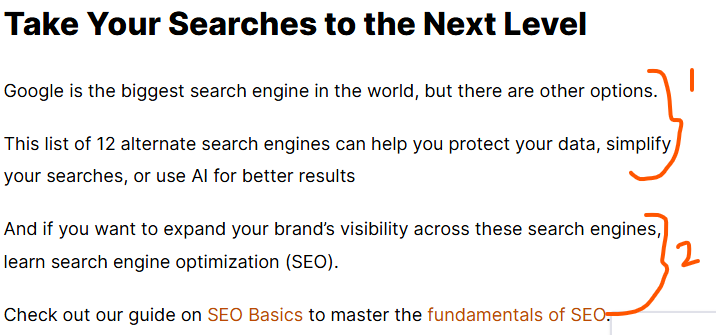
Image source: Backlinco blog
After reading the complete article, I looked forward to reading the conclusion. It leads with a new truth (the importance of learning SEO), then goes ahead to help the reader in achieving the next steps, “learn seo” introducing their SEO guide.
Did you notice the smooth progression from information to discovery, to “here’s what you need to do next” without hard selling?
That is what I consider a good conclusion.
How do we write for search engines and AI?
Most of the steps we talked about are great for writing content that humans want to read, but what about search bots and AI?
I have discovered in my 7+ years of content writing that writing for humans is not so different from writing for search bots and AI.
The major difference is the structure.
While human-first content hammers on value, search bots and AI content are looking at value in relation to the structure of the article.
For search engines (Google), the article structure should reflect experience, expertise, authority, and trust (Google’s EEAT update). These are the things we’ve discussed already.
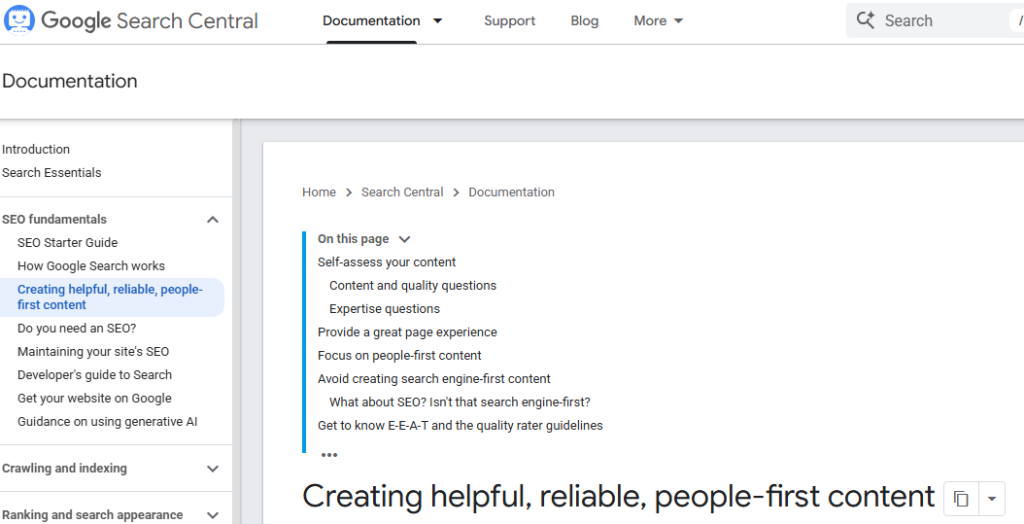
Image source: Google search central
When I went through Google’s EEAT update, I understood the goal is to ensure website owners publish helpful and valuable content.
As for AI, I understand it is optimized for information completeness and for answers. That is why it is called answer engine optimization (AEO). It prioritizes content that answers questions.
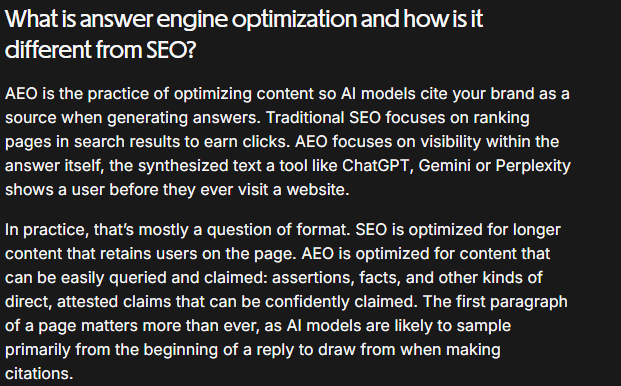
Image source: Content Stack
That is why it is important to answer important questions in your headings (H2s and H3s)
Research helps discover questions your target audience is asking. There are loads of tools that make this process fast and easy.
Now, you understand what it takes to write good content. I am sure you can do it; the more you practice, the better you become.
It is time for step 2.
Step 2: Understand how to serve both the business (promote products and services) and the readers

Writing content for a business to educate its audience and lead them to take the next steps is different from just writing good content.
I discovered the difference after 2 years of working as a content writer. Before then, I thought writing creative and interesting articles was enough.
Turns out, I was wrong (wink, wink).
I discovered two things that changed my perspective as a content writer:
- Readers only care about the solutions to their problems
- Businesses care about efforts that translate to business outcomes
These two things had nothing to do with me as a writer (sadly). None of the two sets of people involved cared about my writing.
This sounds selfish, but when you have this at the back of your mind whenever you write, you are on your way to writing:
A value-driven piece of content that means something to the business and its customers.
Let’s start with the first set of people: The reader.
How can you serve the reader?
You can serve the reader by:
- Answering their most pressing questions
- Providing solutions to their most painful problems
These are the two things they care about. That is why it is important to do your research before you touch the keyboard. That is how you find out what they care about.
Aside from using keyword tools, you can search places where your target readers hang out and have conversations. Here are some of the places I check:
- Online forums (Reddit & Quora)
- Groups on social media
- Competitor review pages
- Customer complaint forms
- Sales conversations
The best place to check depends on the niche you are writing in. If it’s for a lifestyle brand, you can find real customer insight on forums like Reddit.
You get to see how people feel about a particular topic without guessing:
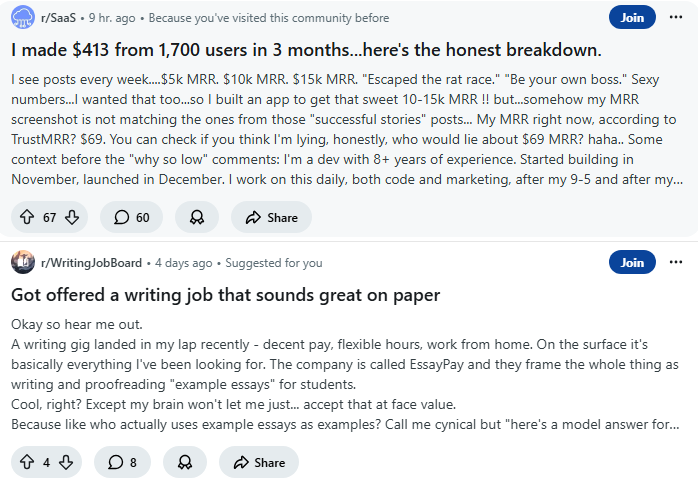
Image source: Reddit home page
The one thing I keep in mind when writing an article that serves the reader is: VALUE.
I want to ensure that my reader finds the article valuable. I achieve this by first understanding what value means to them.
We have learned how to serve the reader, but what about the business paying us?
How do you serve the business?
I have learned how to serve the businesses I write for by understanding the business problem and what the business is trying to achieve with a particular piece of content.
It is about matching a business-specific problem with its target goal using content. From my 6+years as a digital writer, I have noticed businesses have 5 major problems:
- The traffic problem
- The conversion problem
- The Energy problem
- The fulfilment problem
- The clarity problem
A business may want to solve one or a combination of these problems using content. Your job as a content writer is to ensure that your content is optimized to the specific problem the business wants to solve.
That means your content strategy should match the business problem perfectly to get the desired result.
Let’s say a business has a traffic problem; your content strategy should be optimized for that by doing the following:
Understanding the business’s preferred traffic source
Website + Search engine (Google search traffic)
Website + AEO (AI)
Website + Socials (Facebook, Instagram, LinkedIn, etc)
Website + Email
Understanding the business’s preferred traffic source (where they are strongest) will influence your content strategy and writing structure from the beginning.
For example, if the business’s preferred traffic source is website + search engine, you want to go hard on what Google loves to see from a website’s content.
Do you remember the E.E.A.T we talked about earlier? Yes, you should be optimizing for that. Aside from that, you want to make sure you nail your technical and on-page SEO.
Ensure technical SEO stuff like (core web vitals)
This is usually not in your domain. The website owner/the SEO team will take care of the technical stuff.
Let’s look at SEO stuff that concerns you:)
The on-page SEO optimization checklist
This checklist gives you an idea of things to look out for. You have the on-page seo markers and the technical on-page seo markers.
Here’s the simple checklist.
Keyword Optimization:
- Target a specific long-tail keyword for each page.
- Include the keyword in the title tag, specifically near the beginning.
- Place the keyword in the first 100 words of the content.
- Include keywords in H1 and H2 headers.
- Use keywords in the URL slug.
- Content Quality:
- Create unique, high-quality, and comprehensive content.
- Match the user search intent (informational, transactional, etc.).
- Ensure proper formatting for readability (short paragraphs, bullet points).
- Include a clear Call to Action (CTA).
Technical On-Page:
- Optimize meta descriptions to increase CTR (around 160 characters).
- Ensure only one H1 tag exists per page.
- Add descriptive alt text to all images.
- Implement internal links to other relevant pages.
- Add external links to high-authority, relevant sources.
- Keep URLs short and simple.
This is just one example;
Understanding the traffic source and knowing how to win there sets you up for success without confusion.
Bottomline:
I believe that once you match user intent perfectly, then you are most likely hitting the business goal. Like they say, “happy customer, growing business”.
It is all about satisfying users at the end of the day.
Step 3: Build Experience

You know what good writing is; it is time to put in the reps to ensure you produce good writing.
I used to feel like I already knew something after learning about that thing (that’s how most people feel).
The satisfaction of finally completing a course. I usually feel like the most knowledgeable person ever (Don’t judge me).
Turns out, I was wrong.
Although you get some level of knowledge when you learn about something. However, you get a deeper level of knowledge when you experience that thing for yourself. When you actually do the work.
Here’s how to experience good writing for yourself:
- Practice
- Practice
- Take feedback
- Practice again
- Learn
- Practice
I know I have mentioned practice for an unhealthy number of times (Don’t be angry), I can’t help but tell you the truth.
No amount of content writing courses can help you skip this process (the not-so-cool part)
This list sounds funny, but it is exactly how it works.
Many people spend too much time taking courses and learning – I used to be that person too, until I discovered it is just fear dressed up in preparation.
I do not believe in taking all the courses before launching out. I believe in understanding the foundational truths (basics), then moving on and putting in the real work.
This is where the most valuable learnings happen.
Here’s a quick checklist to help you build your experience as a content writer:
- Start writing about anything that interests you (look at your skills, interests, abilities, hobbies, etc.)
This is a great place to start. You want to start doing what already interests you; this will help you build initial momentum (without questioning your career choice, at least at the beginning)
However, I won’t advise you to write and leave the piece lying somewhere in your folder. I will advise you to make your articles live on the internet.
Medium.com is a great place to do so with $0. You share your ideas with others, learn to write the kind of stuff people want to read, build relationships with other writers, plus it serves as a writing portfolio.
Isn’t it cool?
- Create a writing schedule and commit to it
Writing frequently has helped me hone my writing skills. Just like every other thing in life, the more you do, the better you get at it.
It doesn’t matter if your writing isn’t great now. You go from “amateur writer” to “pro-level” writer by REPs. There is no other way.
There is one thought I keep in my mind when I want to start anything. It is – you can be better than everyone else if you do it more than everyone else.
I recommend writing and reading every day to build your writing experience. It mustn’t be 2000+ words stuff; you can mix things up. For example, write long-form on Medium, average on LinkedIn, and short-form on X.
Mixing things up like this makes it more fun and less rigid, plus you get to learn other writing styles and some level of content creation.
- Start writing for businesses/clients
Aside from writing fun stuff, it is good to build experience writing for a real business. So that you get someone to read through your work, build hands-on experience on writing that contributes to business outcomes.
You might be thinking; how do I go about it?
Here are a few ways you can get started:
- Volunteer as a writing assistant or subcontractor (pitch an experienced writer to get started). LinkedIn and X are great places to find them.
- Create an account on freelance marketplaces like Fiverr & Upwork (start with small gigs)
- Start writing a guest post
Some websites need writers to contribute to their blogs via guest posting. You find those opportunities easily by doing a simple Google search. Simply type in “write for us”, “looking for contributor writers, “guest post guidelines”, etc., into the search bar.
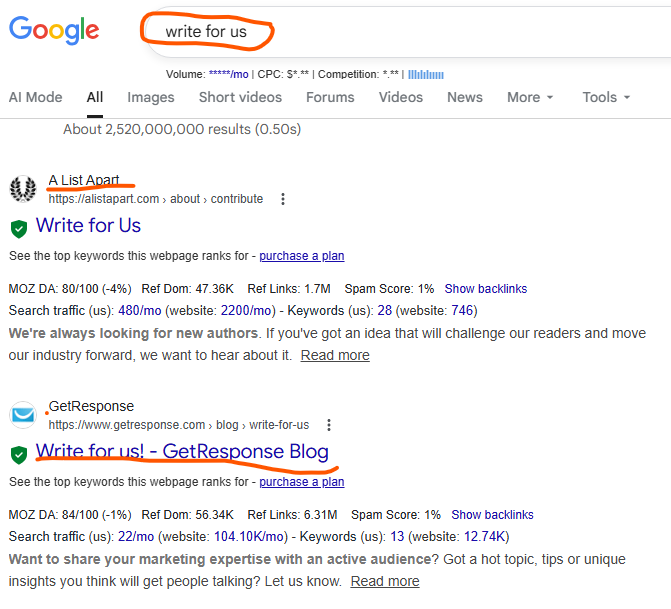
Image source: Google’s SERPs
Here’s the interesting thing about guest blogging people don’t talk about – it can be a quick way for you to land your first writing job with little to no competition.
The goal is to do a great job, communicate well, and hit deadlines as quickly as possible.
- Follow other writers and keep learning (LinkedIn, Medium, forums, etc.)
One of the ways I learn is to see what other writers are doing. That is the power of networking. When I started writing, I was more concerned about landing writing gigs – so, I prioritized following businesses over peers.
I realized it wasn’t a good idea. You learn from fellow writers; writing hacks, how they use AI, how they find clients, what is working now, etc. I understand you want to network up, but don’t underestimate the power of networking sideways.
LinkedIn is one of the best places to learn from other writers. You don’t have to be besties (even if I don’t mind being your bestie); these writers post about their work, you can follow their progress, and learn.
The goal is to keep learning and practicing what you learn. This is basically how you build experience as a content writer.
Not forgetting tracking your result, always ask about your article (how many views, how many sales, sign-ups, etc.).
This will help you build a solid, value-driven portfolio.
Step 4: Create your free content writing portfolio (A brand story of your best works)

Once you’ve built a level of experience, it is time to create a portfolio of your best works. I refer to the portfolio as a brand story of your best works, because that is the best way I can explain it.
In my first years as a content writer, I didn’t really understand the real meaning and purpose of a portfolio. I thought it was just a list of things I had written.
This is exactly how my portfolio looked:
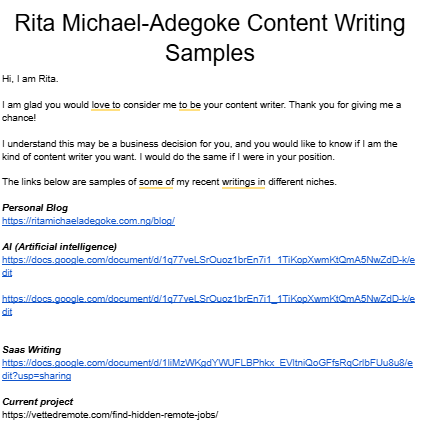
I sent this portfolio out to apply for jobs (international remote writing jobs), and wondered why I got ghosted or, at most, a rejection email.
(covers face in shame).
A few years down the line, I understood what a portfolio is and the purpose it serves. I will explain it to you in a few minutes, so you don’t repeat my mistakes.
A portfolio is basically the show version of your CV/resume.
In your CV, you talk about your personal information, experience, skills, tool proficiency, etc. In your portfolio, you show how you achieved results with all you have.
It is more like a proof of your CV.
In your CV, you say you did ABC. You have to prove you did ABC in your portfolio by showing:
- The problem the business experienced
- How you approached the problem (your process)
- The effect of your approach (the result)
The goal is to walk your potential client through your work process and the result you have gotten. This will give them an idea of how you can replicate the same result for their business.
There is something unique I like to include in my portfolio – my personality. I always love to show a bit of my personality to give whoever is reading an idea of who I am.
That is because I think I am cool (just being cocky)
Here’s a sneak peek at one of my current portfolios:
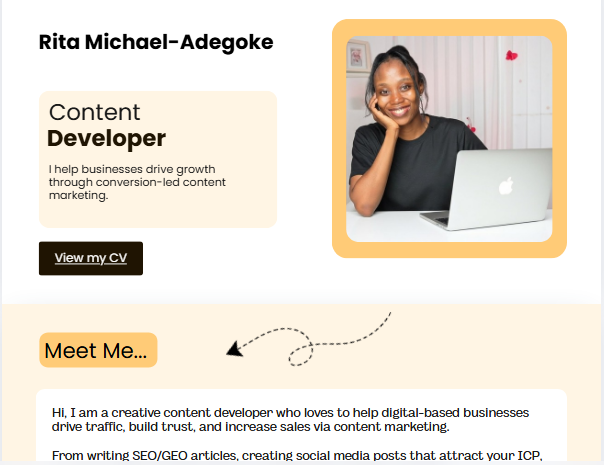
I made a detailed video on how to create a portfolio for free. I used free tools (Canva & Notion)
These videos will walk you through how you can do the same thing step-by-step:
If you are wondering what a great CV should look like in 2026, here is another detailed video to guide you in creating one.
Step 5: Position Yourself for content writing opportunities, the road to $1000/month
When most people think of making money from writing, they mostly think along these lines:
- Learn to write
- Start applying for jobs
- Keep applying until something happens somehow
I think about it a little differently.
I like to think about content writing as a solution instead of something I can’t wait to sell. Doing this takes away the desperation and allows me to position myself strategically.
Here is a 2-way process I use to attract opportunities without appearing desperate:
- Optimize my offer to be found by the right people
- Reach out strategically with a proven solution
This approach makes it less of a job search, but more of providing a solution to businesses.
Here’s a simple checklist to achieve 1 & 2 above.
Optimize your offer to be found by the right people
Google your name and see what shows up.
(not impressive, let’s change that)
- Create an irresistible offer (an offer is different from your skill, what solution are you providing)
- Create an account on freelance marketplaces and optimize them around your offer.
- Create an account on LinkedIn and optimize for visibility
- Create an account on Medium for added visibility and expertise
- Choose one social media platform to share your experience for added visibility.
- Start guest blogging to build authority
This might not look like how you would quickly make money as a content writer. Yes, you are right.
The great thing is – it works.
Why?
Because it compounds.
And when it starts to yield results, it does big time.
The difference between amateur content writers and pro-content writers is visibility + authority. This is what determines how much you earn these days (to a large extent), aside from skills.
You might be a top-notch content writer, but if no one knows or perceives you as one, then you are likely not. We live in an attention-driven society (sadly).
You literally need to let people know you are great at content writing. Should you scream, “I am great at content writing from the rooftops? (lol)
Not exactly, but how you show up online can help you do that.
Let me give you an example of how you can do this using LinkedIn or any social media platform.
Social media for career/business 101
Here’s a simple way I treat my social media to position and sell myself without applying for a job:
(Take out your note and pen, it is time for class 🙂)
Profile = Landing page
Converts profile visits into interest
About section = Authority + proof
Answer “Why should I trust you?”
Content = Free ads + expertise
Attracts the right people
Pinned post = Lead magnet
Captures intent
Followers = Social proof
Builds credibility
Comments = Visibility distribution channel
This is your organic reach hack
DMs = Conversion engine
This is where money is actually made
Here’s a simple way to think of it:
The simple way to think about it:
- Content brings people in
- Comments expand your reach
- Profile builds belief
- DMs close the deal
This doesn’t mean you should not be human on here. LinkedIn is a networking first platform, so you want to relate naturally with other humans (You don’t have to be a weirdo)
This is how people who say business owners reach out to them with an offer on LinkedIn do it (at least most times).
Here is a great read to learn more: How I got a remote job from LinkedIn
I know it works because I have tried it. A business in Canada reached out to me with an offer I did not apply for:

Image source: LinkedIn message screenshot
While content creators are focused on making viral posts and making friends, focus on providing value, showing expertise, and building authority if you want to attract opportunities (plus make friends too).
This happens on other platforms like Fiverr, social media, etc.
Positioning yourself online as a key person of influence in your niche opens up other income streams you may never have thought about.
Aside from writing gigs, you can get brand partnerships, you can have a paid membership group, and give more value to your readers by packaging your knowledge into digital products to help them more.
And the list goes on…
Reach out strategically with a proven solution
There’s just something beautiful about the feeling of getting job offers without sweating – A total bliss. However, you can’t control when this happens.
Once a month, twice a month, once in 6 months, twice in 1 year … it all depends.
This is where the power of strategic outreach comes in. You can control what happens to a great extent. One thing I have learnt about outreach is that it is a valuable numbers game.
The more people you reach, the higher your chances of getting a response. However, you don’t want to do the “spray and pray” approach.
I recommend you send one personalized outreach at a time.
Learn more: How I got a remote job as a content writer
Think about it, would you send 100 cold outreaches and get 0 responses, or send 5 and get 2-3 responses?
This was my exact situation. I had sent about 100 outreach messages without getting a response. When I understood the secret to outreach and learnt more about sales, almost every outreach message I send gets a response.

Image source: LinkedIn message screenshot
I sent this message at 6:17 pm, and got a response at 6:19 pm.
I literally sent this message and got a response about 2 minutes after.
What changed? My approach. I started following this simple process:
- Create a solution-based offer that matches the target client’s problem
- Do deep research on the client (literally trailed them to get signals that they need my service), and what success feels like for them
- Create a mini version of the solution (write a good article, or the equivalent of your skill), walk them through my first 30 days on the job (if it is a job opening), working for free and asking them to pay when they get a result, etc.
- Sending the message where they are most active (Following my Beyond & Above strategy)
- Following up strategically with a touch of personality
This is basically how I do my outreach, and it works. Although there are more details like:
- Where to find the clients
- How to know if they need my services, etc
I shared more details about these and more in my course and free e-book. Click the link below to get it.
Step 6: Build momentum and scale (create a client pipeline + build a personal brand)

This is when you start to treat content writing like a real business. Real businesses have systems for client acquisition.
Many content writers have the approach of looking for jobs/client when they are out of jobs, or when a contract ends. I don’t think it is a sustainable way to grow.
That is why freelance writers often complain of feast and famine seasons. Today, they are juggling clients; tomorrow, they are making an “open to work” post on LinkedIn.
The sustainable way to ensure you always have work is to figure out the client acquisition method that works for you. Then create a system for attracting and qualifying these clients.
For example, if you are an outreach person, you can create a client acquisition that allows you to send 10 outreach per week to potential clients (whether or not you have work).
If you are more of an inbound person, you can choose a traffic source to consistently market yourself and create a system to funnel/qualify potential clients.
It can look something like this:
Strategic YouTube videos = lead magnet = Website = contact form = sign contract
This might look different for different people, but the bottom line is to create a system that consistently brings in leads. This is exactly how businesses work.
Building something new/week can also be a part of the system.
Building a personal brand
Once you have created a system for client acquisition, it is time to build a personal brand. In recent times, I can’t overemphasize the importance of building a personal brand.
I see it as discovering what you want to be known for and attracting people with the same interests. Personal brands thrive on value creation, which will, in turn, position you as a key person of influence in your niche.
This is when you start to own something, build influence, and scale your writing business. This is exactly what separates pro content folks from amateurs. It also opens doors for other income sources.
My unpopular opinion as a content writer
Writing is one of the most valuable skills anyone can acquire. Once you really know how to write, you can make a lot of money and, most importantly, influence people positively.
Text is the foundation of every content format.
Many people learn content writing because they want to get a job. There is more to knowing how to write than getting a job; you can build a profitable business as a writer.
You don’t have to work for one person when you can serve thousands of people with the skill you have. AI or not, I believe writing is still one of the most valuable skills.
You don’t agree with me? Prove me wrong in the comments 🙂